
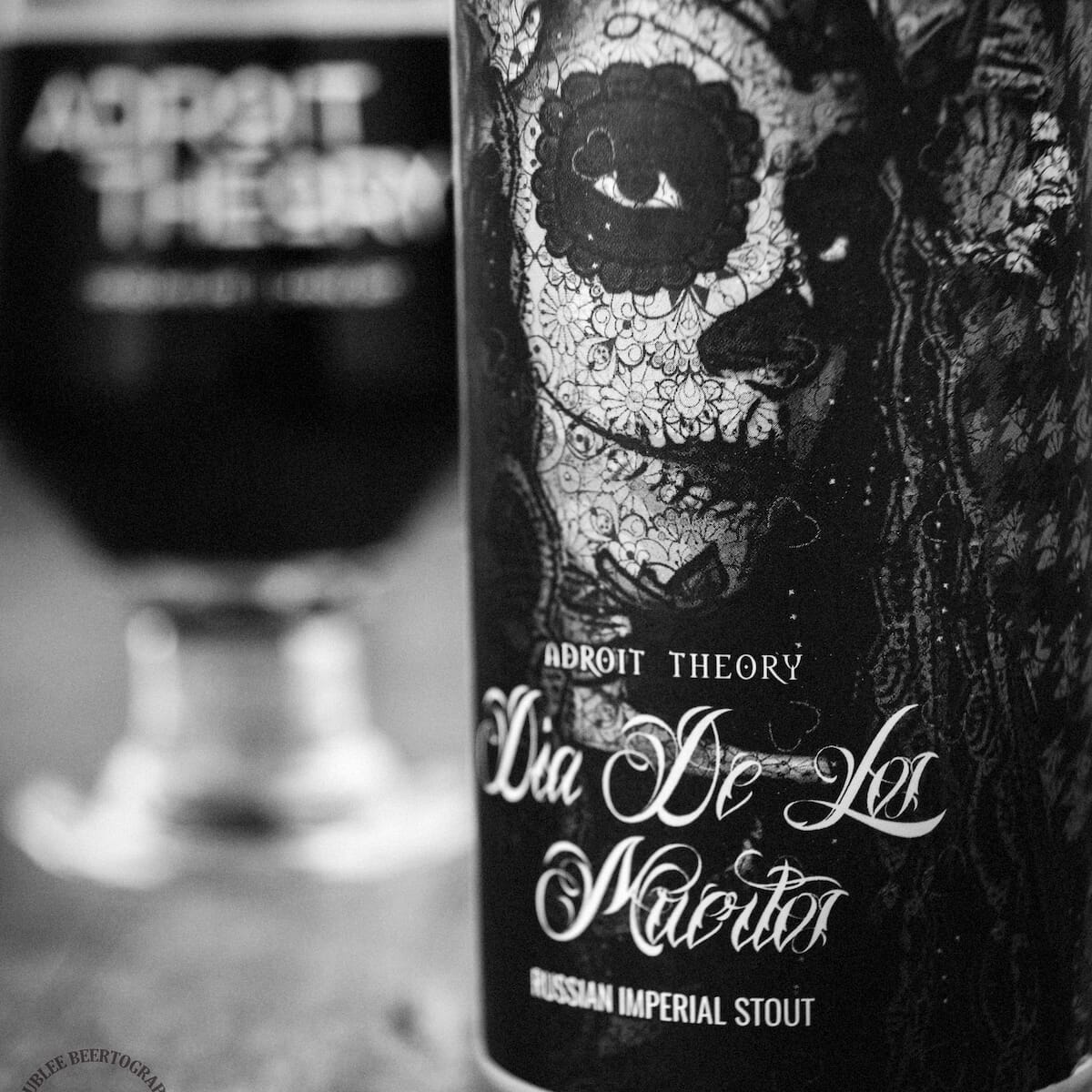
Adroit Theory Brewing Company has put its flagship stout back in cans, and it arrives with the largest package run of the brewery's three new canned releases this week.
Dia de los Muertos is a Russian Imperial Stout, and the brewery's description of it runs longer than most of its release copy. The beer pours jet black and opaque under a deep tan head. Roasted maltiness leads, according to Adroit Theory, with subtle fruity esters, hop bitterness and balanced alcohol arranged behind it. The flavors it points to are bittersweet baker's chocolate, cocoa and fresh roasted dark coffee. The body is full, with what the brewery calls a velvety, luscious texture.
Then comes the unusual part. The release notes ask drinkers to swirl the glass and observe the viscosity legs - the streaks that run back down the side after the liquid settles.
That is a borrowed habit. Legs belong to wine and spirits tasting, where they indicate alcohol and dissolved sugar. The same physics applies to a beer, but very few are dense enough to make the exercise worth doing. An imperial stout brewed to this weight is one of the exceptions, and the instruction is effectively the brewery pointing at its own gravity.
The balance claim follows from the same place. Adroit Theory says the residual sweetness is just enough to conceal the alcohol and offset the bitterness, which is the line a Russian Imperial Stout is always walking. Roast and alcohol both push hard in the same bitter direction, and what keeps the style from turning harsh is having enough unfermented sugar left to absorb them.
Dia de los Muertos is available now at the Purcellville taproom on draft and in cans, with six cases packaged.
Source & Editorial
JollyPint independently prepares release articles using information published by breweries through newsletters, websites, and other official public communications. Brewery-supplied descriptions and tasting notes are reported as provided, while editorial context is added by JollyPint.