
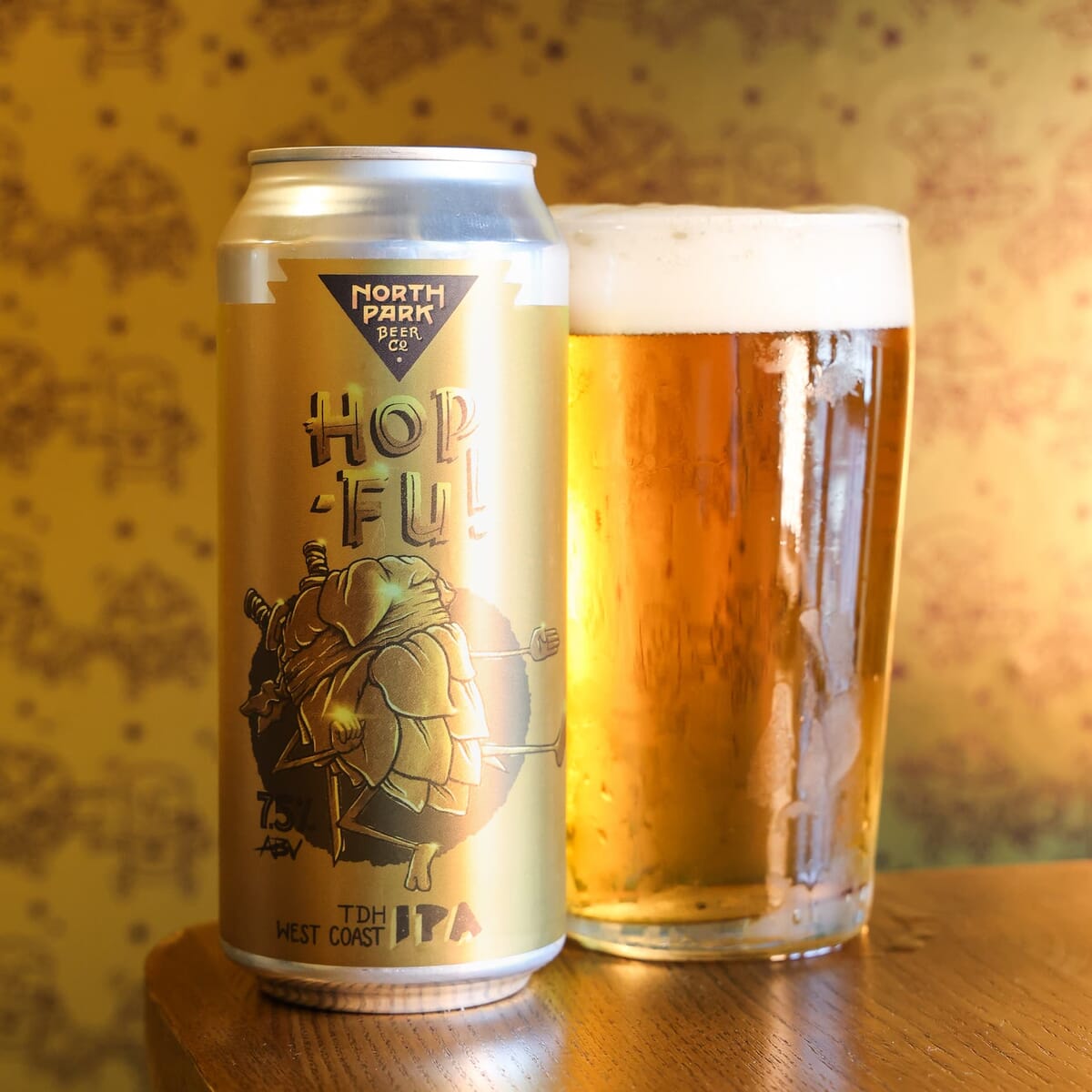
Hop-Fu! is North Park Beer Co.'s flagship, and the standard version is double dry-hopped. This one is not.
Double is good but Triple is better.
That is how the San Diego brewery introduces TDH Hop-Fu! Gold Edition, a triple dry-hopped West Coast IPA arriving in cans on Wednesday at 7.5 percent ABV. The can is metallic gold, with the familiar robed hop cone rendered in gold on gold, sword drawn.
Seven hops go in: Chinook, Strata, Krush, Amarillo, Simcoe, Citra, and Mosaic. North Park describes the result as sticky, dank, crisp, and clean, with a dry finish.
The list underneath the list
The hop bill splits fairly neatly into two jobs. Chinook and Simcoe are the old-guard West Coast varieties, the ones responsible for pine and resin, and their presence is why this reads as a West Coast IPA rather than a hazy in disguise. Citra, Mosaic, Amarillo, and Krush handle the fruit. Strata is the interesting inclusion, a comparatively recent Oregon variety known for a dank, passionfruit-and-cannabis character that sits between the two camps rather than in either.
Loading that many varieties into a beer that also wants to finish dry is the balancing act. A West Coast IPA has less residual body to hide behind than a hazy does, so hop character has to arrive as aroma and bitterness rather than as sweetness, and anything overdone shows up immediately.
The tasting notes North Park supplies lean hard toward candy: grape Jolly Ranchers, strawberry Gushers, zesty lemon-lime, mega sinensis orange, and piney resin. Sinensis is the species half of Citrus sinensis, the sweet orange, which makes it the one technically precise term in a list otherwise built from convenience-store shelves.
The Gold Edition joins three other cans in this week's release, including a 10 percent triple IPA and a 4.2 percent XPA. It goes on sale Wednesday at the taprooms, with pickup pre-orders and California shipping through the brewery's site.
Source & Editorial
JollyPint independently prepares release articles using information published by breweries through newsletters, websites, and other official public communications. Brewery-supplied descriptions and tasting notes are reported as provided, while editorial context is added by JollyPint.