
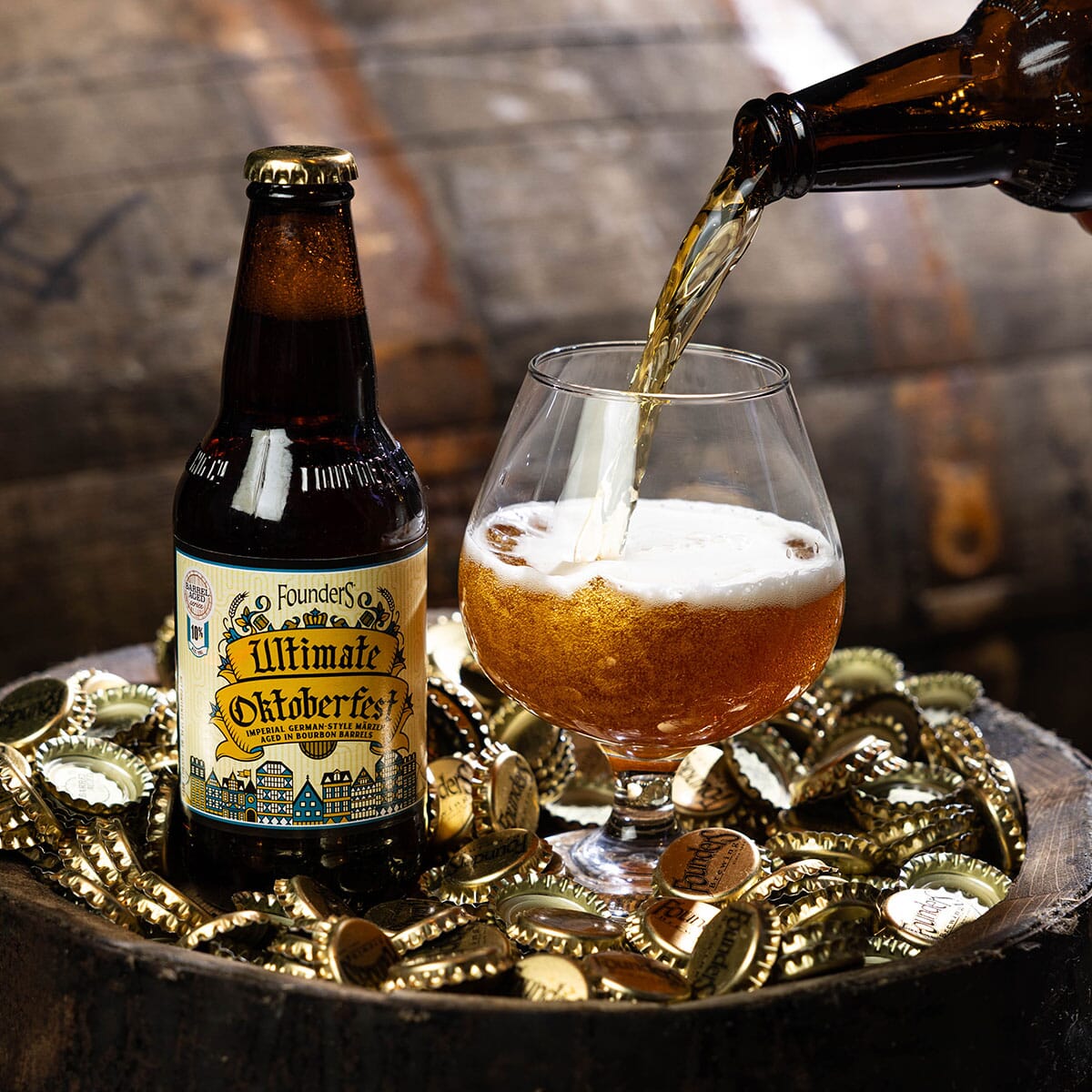
Bourbon barrels are usually reserved for the heaviest thing a brewery makes. Founders has been putting a Marzen in one.
Ultimate Oktoberfest is back for the autumn, and the method has not changed. A classic German-style Marzen goes into bourbon barrels and stays there for nine months. It comes out at 10 percent ABV. The brewery is selling it in the Grand Rapids taproom and on shelves, in four-packs of 12-ounce bottles.
Founders describes notes of bourbon and caramel, moderately sweet with a light bitterness to round it out. The brewery's spec sheet extends that list to sweet bread and baking spices.
Barrel programs tend to run on imperial stouts, barleywines and porters. Those are beers with enough body and residual sugar to absorb a long stay in oak without being flattened by it. A Marzen has none of that. It is a malt-forward amber lager built on restraint, traditionally somewhere around 6 percent. Its whole appeal is a clean finish, and nine months in bourbon oak is not a subtle input.
The answer is printed on the label, which reads Imperial German-Style Marzen. The beer was scaled up before it ever went near the wood. At 10 percent there is enough malt weight and sweetness to meet the barrel rather than be erased by it, and the label carries a Barrel Aged Series mark to match.
What is striking is how little else changed. Founders lists Magnum and Perle, both German bittering hops, at 20 IBU. That is a traditional, restrained Marzen hopping that would suit a beer half this strength. The malt bill is equally orthodox: Pilsner, Munich and aromatic malts. Everything unusual about this beer happened after fermentation, in a barrel, over nine months.
Founders lists Ultimate Oktoberfest as a seasonal running from August through October. It is pouring in the taproom now and is on shelves across the brewery's distribution footprint.
Source & Editorial
JollyPint independently prepares release articles using information published by breweries through newsletters, websites, and other official public communications. Brewery-supplied descriptions and tasting notes are reported as provided, while editorial context is added by JollyPint.