
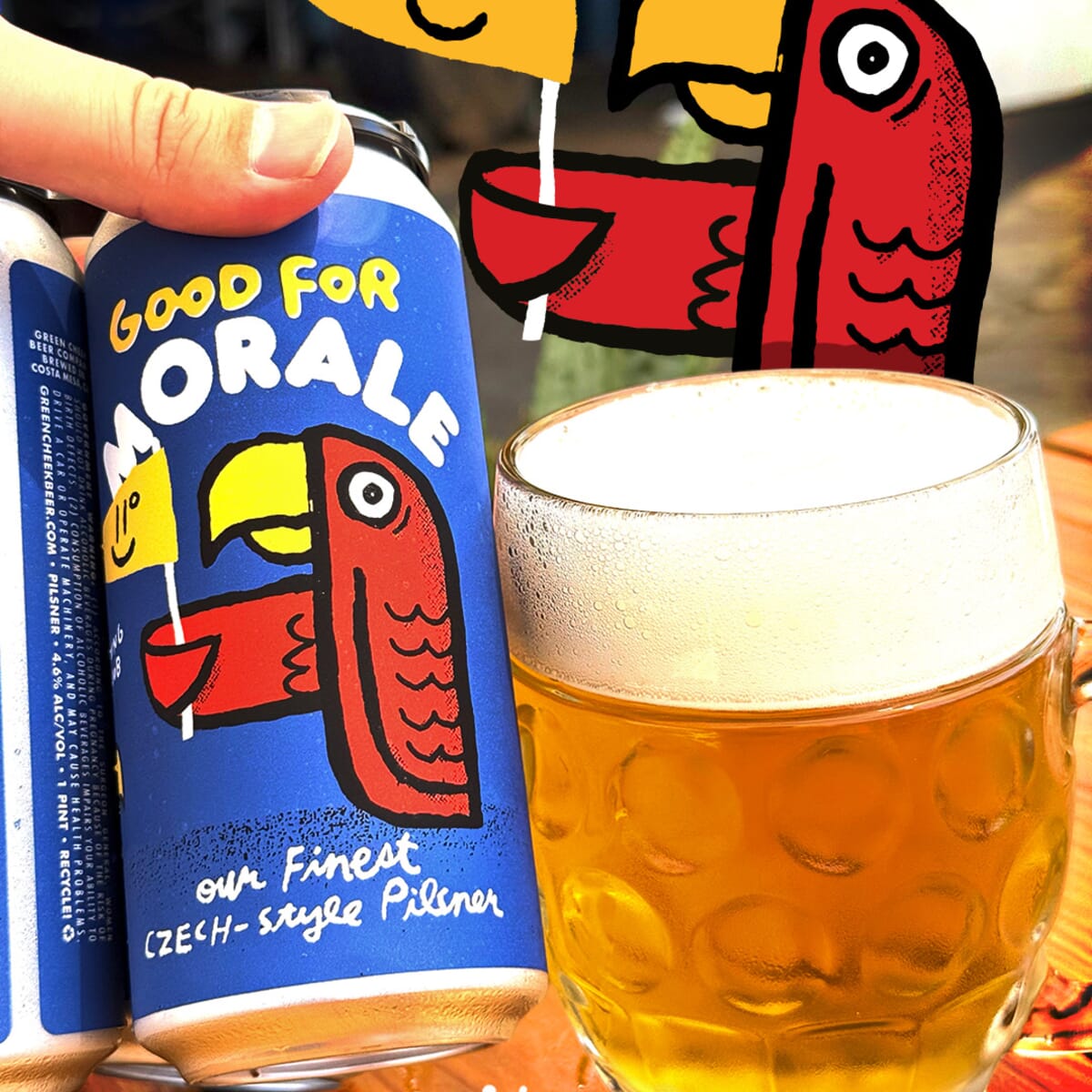
Most beer gets its bubbles added at the end. Good For Morale does not.
Green Cheek Beer Company's Czech-style pilsner is spunded. The fermenter gets sealed before fermentation has finished, so the carbon dioxide the yeast is still producing dissolves into the beer under its own pressure. Nothing is injected afterward. Brewers who work this way say the carbonation comes out finer and softer than gas from a tank. Green Cheek describes tiny bubbles.
That is one of several slow decisions in a 4.6 percent beer. The malt is floor-malted pilsner malt, made the old way. The grain is spread in a thin bed across a large floor and turned by hand rather than tumbled in a drum. Only a handful of Czech and German maltings still do the work that way. Brewers reach for it because the gentler, less uniform modification tends to leave more malt character behind.
The hops are Saaz, and the brewery specifies "from the motherland." That distinction is worth keeping. Saaz grows in the United States as well. Brewers generally treat the Czech-grown crop as a different ingredient, softer and more herbal. In a beer with this little else going on, that difference accounts for a good share of the flavor.
The yeast was chosen on the same logic. Green Cheek says it picked a lager strain that helps express the maltiness of the beer. That inverts the usual instruction, since most of the job in a pale lager is to get out of the way.
Add it up and the brewery's comparison holds together. It describes the beer as richer and fuller than a German pils, with a dab of mid-palate sweetness set against the fine bitterness the style expects. The tasting notes are doughy bread, alpine herbs and a little honey. That first one is the floor malt talking.
Good For Morale dropped Wednesday. Four-packs are 15 dollars.
Source & Editorial
JollyPint independently prepares release articles using information published by breweries through newsletters, websites, and other official public communications. Brewery-supplied descriptions and tasting notes are reported as provided, while editorial context is added by JollyPint.