
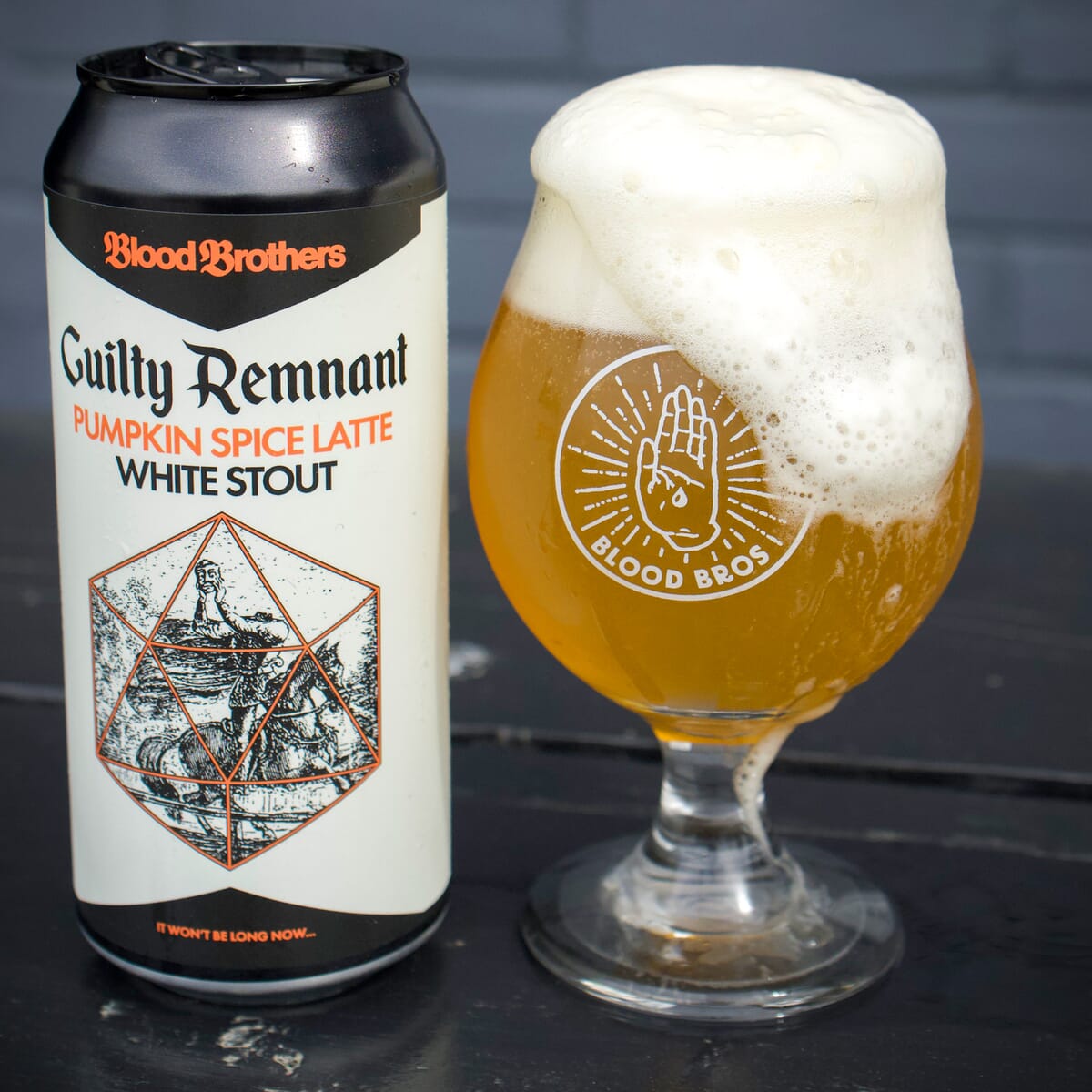
Take away a stout's roasted malt and you would expect to lose the stout. Blood Brothers Brewing's answer has been to remove it anyway and then put the missing flavours back by other means.
That is the premise of Guilty Remnant, the Toronto brewery's white stout, which returns this week in a pumpkin spice latte version at 6.0 percent ABV. The brewery describes it as brewed with all the elements of a traditional stout but without the roasted malts those recipes normally lean on. In place of the grain, the beer is infused with locally roasted Hale Toriba coffee beans and vanilla, which Blood Brothers says supply the fresh roasted coffee and white chocolate aromas the beer is known for.
The substitution is the whole idea. Dark roasted malt is what gives a conventional stout its colour and much of its coffee-and-cocoa character, so pulling it out normally costs a brewery both at once. Using actual coffee restores the aroma without the pigment, which is why a white stout ends up pale in the glass while reading as something considerably darker to the nose. It is a style that only makes sense once you accept that the roast was always doing an impression.
Pointing that base at a pumpkin spice latte is a short step rather than a leap, given the coffee is already in the recipe. For this version, Blood Brothers says smooth vanilla and creamy lactose notes blend with fresh coffee, warm pumpkin spice and light bready malt, with hints of cinnamon and nutmeg over a soft, silky body. The brewery describes the finish as sweet, aromatic and dessert-like.
Lactose is the quiet mechanic here. Brewer's yeast cannot ferment it, so it stays in the finished beer as residual sweetness and body - the closest a brewery gets to putting the steamed milk of a latte into a can.
Guilty Remnant Pumpkin Spice Latte is available now from Blood Brothers, which operates out of a century-old former horse stable on Geary Avenue in Toronto's west end.
Source & Editorial
JollyPint independently prepares release articles using information published by breweries through newsletters, websites, and other official public communications. Brewery-supplied descriptions and tasting notes are reported as provided, while editorial context is added by JollyPint.