
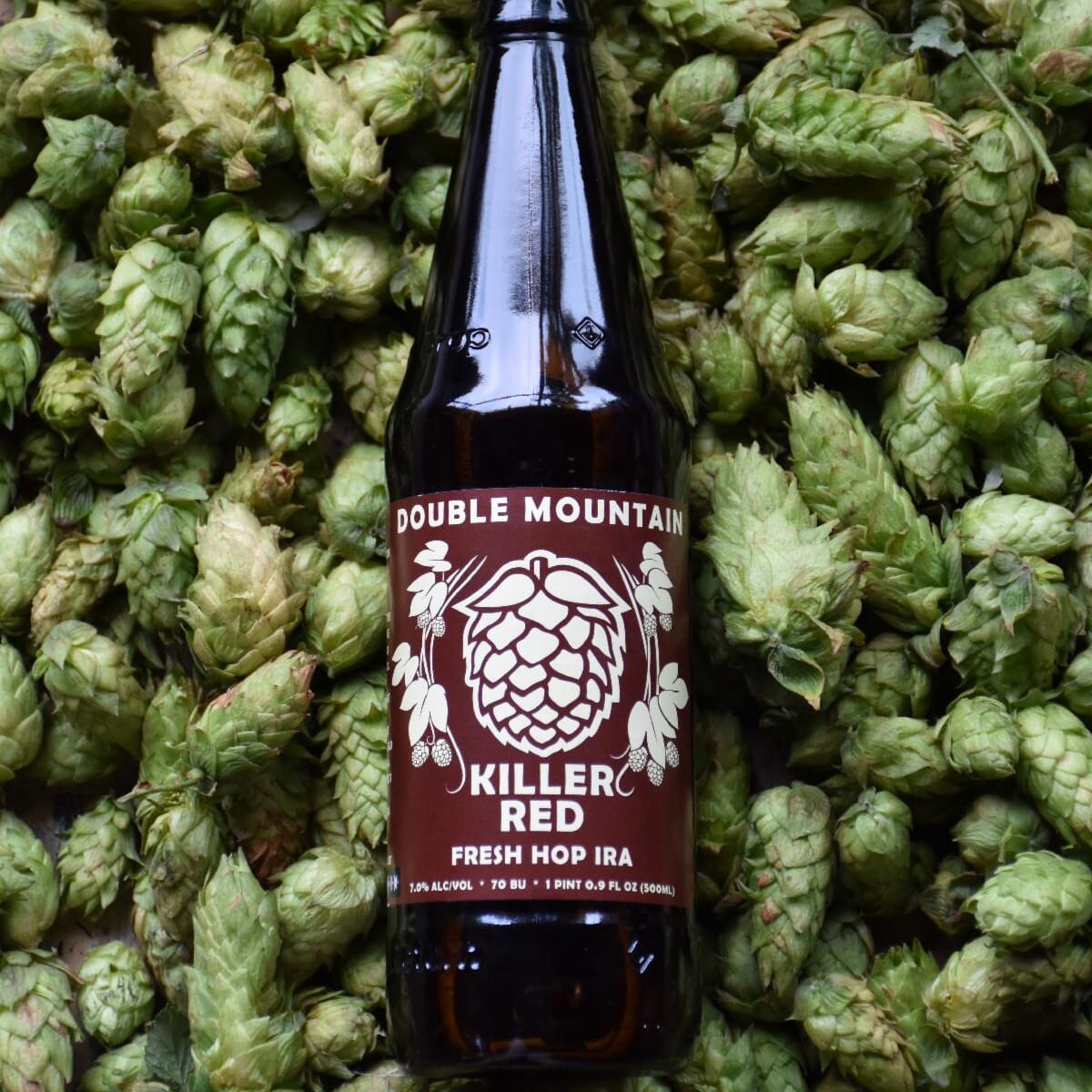
Killer Red never meets its fresh hops in the kettle. Double Mountain packed more than 400 pounds of wet Centennial into oversized hop sacks, lowered them into the brite tank, and left the finished beer to marinate on top of them.
It is the first of four fresh hop beers the Hood River brewery has brought out this year, and by its own account always the first one out of the gate. The Centennial came from Crosby Hop Farms in the Willamette Valley. Double Mountain describes the result as resinous citrus and pine, carrying what it calls the sticky, green, fresh-hop goodness the brewery looks for this time of year.
The brite tank is the detail worth sitting with. It is the last vessel a beer passes through, after fermentation has finished and the temperature has come down, which puts this addition much closer to a dry hop than to anything done on the hot side. There is no boil to drive off the volatile oils that make a wet cone worth hauling across the state in the first place. What the hops give up, they give up slowly, into cold beer, over time. Bitterness largely stays behind. Aroma does not.
The base is a red ale, and the label says so plainly: Fresh Hop IRA. Double Mountain keeps a year-round IRA in its lineup, an India Red Ale at 6.5 percent that the brewery builds on Brewer's Gold in the kettle with Brewer's Gold and Simcoe in the hop back, finished with Kolsch yeast and pitched at drinkers of ambers and IPAs alike. Killer Red arrives at 7.0 percent and 70 BU. Swapping the fresh-hop charge onto that frame is a different proposition than laying it over a pale malt bill, because there is caramel and red fruit underneath it rather than open space.
Double Mountain frames the whole season as a race against the clock, getting cones from the farm into the kettle, hop back or brite tank as fast as the crew can manage. The brewery's line for it is that fresh hop beers capture a moment in time.
Killer Red is pouring now at the original Hood River taproom and at the two Portland taprooms in the Woodstock and Overlook neighborhoods, and it is available on tap and in refillable 500 ml bottles across the Pacific Northwest. Those bottles are worth a word of their own: Double Mountain packages in returnable glass that gets sorted, washed and refilled rather than recycled, and puts its running total at just under 2.9 million refillable bottles sold to date. Empties come back at any Bottle Drop location or at a taproom, where 24 of them earns six dollars off the next visit.
Source & Editorial
JollyPint independently prepares release articles using information published by breweries through newsletters, websites, and other official public communications. Brewery-supplied descriptions and tasting notes are reported as provided, while editorial context is added by JollyPint.